
Article may contain affiliate links. As an Amazon Associate I earn from qualifying purchases.
 The 7.3L Power Stroke first became available for customer use in the middle of 1994. The engine was produced by International, with the Powerstroke name being unique for the International engines used by Ford.
The engine is based off of International’s T444E with some modifications made for Ford specific applications. Ford used the 7.3 Powerstroke engine in Ford Heavy Duty pickup trucks and Ford Econoline vans.
| 7.3L Powerstroke Diesel V8 Specs | 1994-2003 |
|---|---|
| Displacement (cu in / cc): | 444 / 7275 |
| Horsepower: | 275 hp @ 2800 RPM (2003+) |
| Torque: | 525 lb-ft @ 1600 RPM (2003+) |
| Bore and Stroke (in / mm): | 4.11 x 4.18 / 104.4 x 106.2 |
| Compression Ratio: | 17.5:1 |
| Firing Order: | 1-2-7-3-4-5-6-8 |
| Block Material: | Cast Iron |
| Cylinder Head Material: | Cast Iron |
| Valvetrain: | OHV, 2 Valves per Cylinder |
| Fuel Delivery: | Direct Injection, HEUI |
| Emission Controls: | NA |
| Engine Oil (qt / L): | 15 / 14.2 |
Editor’s Note: Keep your 7.3 running great for years to come with these top rated products:
 |
 |
 |
| Sea Foam SF-16 Motor Treatment | Mr. Gasket Cataclean Exhaust System Cleaner | BlueDEF |
Fuel Injectors and Direct Injection System
The 7.3 L Powerstroke replaced the 7.3L IDI. One of the major upgrades was the change in the fuel injection system. The 7.3L engine introduced direct injection using a hydraulic electronic unit injection system.
At a high level, the injectors work by using an electric signal that allows high pressure oil into the injector unit, and the oil then is used to open the injector needle, which results in fuel injection.
| Alliant Power HEUI Injectors | Alliant Power HEUI Injectors | Delphi EX63803AD Diesel Injectors |
| Cylinders 1-7 | Cylinder 8 | Cylinders 1-7 |
| See Price | See Price | See Price |
In 1999, the Powerstroke began to offer split injections instead of just a single injection. Split injections offer many benefits, but the one likely that is most noticeable to the customer is the noise reduction.
The first injection is usually of smaller quantity, and called the pilot injection. This small burn warms the air in the cylinder and provides a smoother combustion when the main injection occurs.
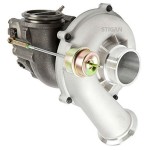
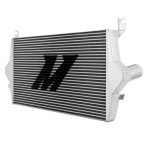
Another key feature was the wastegate turbocharger which then added an intercooler in 1999, which further improved the engine performance.
 |
 |
|
| Stigan Turbocharger 847-1013 | BD Diesel Performance 1047510 Turbo Thruster II | Mishimoto MMINT-F2D-99 Intercooler Kit |
| See Price | See Price | See Price |
The 7.3L engine remained in production until 2003 when it was replaced by the 6.0L Powerstroke. Before stopping production, over 2 million Powerstroke engines were built, with performance and durability being key factors in the popularity of this engine.
Displacement and Performance
 |
 |
 |
| Edge Products 15001 Evolution Programmer | Edge Products 15000 Evolution Programmer | TS Performance 6 Position Chip with Knob (140+ HP) |
| See Price | See Price | See Price |
The 7.3 L engine converts to 444 cubic inches in standard units. The displacement in cubic engines is where name given by International is based on, the International T444E. The bore was 4.11 inches with a stroke of 4.18 inches.
With the changes already mentioned, and other small modifications along the way, performance of the engine significantly increased over the life of the 7.3L engine. At first introduction in 1994, the peak power was 210 hp @ 3000 RPM and peak torque of 425 lb-ft @ 2000 RPM.
With the improvements in fuel injection and turbocharger, among other lesser known improvements, the max horsepower increased by 30% to 275 hp and the max torque increased by 23.5% to 525 lb-ft. The compression ratio for this engine was 17.5:1.
Block and Head
The 7.3 L Powerstroke used cast iron head and block, which also helps explain the excellent durability.
The valvetrain for the power stroke was overhead valves, with 2 valves per cylinder. This means a single intake and exhaust valve per cylinder. These are driven by a standard push rod camshaft.
The 7.3L Powerstroke offered many significant improvements over its predecessor, the 7.3 L IDI, or indirect injection. The Powerstroke was well known for its endurance and reliability.
Ford boasts that over 2 million of these engines are still in service, 12 years after the last Powerstroke was built.
Many of the technologies discussed in this article were cutting edge at the time, and the Powerstroke was an innovative engine. The 7.3L eventually gave way to the 6.0L Powerstroke in 2003, with new emissions regulations being a driving factor.
As emissions standards became tighter, more accurate control is required, and ultimately the decision was to go to the 6.0L instead of making major overhauls to the 7.3L.
With new emissions standards comes more emissions control devices, which simply provide an extra part that could fail. This is also one of the reasons that the 7.3 Powerstroke is still highly sought after to this day.
Learn more about the Powerstoke family of engines:
 |
 |
 |
| 6.0L Powerstroke | 6.4L Powerstroke | 6.7L Powerstroke |
7.3L Engines For Sale: Live Auction Listings
—
Photo via Engine Builder Mag